A Sunday File for One Ongoing Story
A Sunday file for one ongoing story separates confirmed decisions from proposals and unresolved details, so each new update fits the record without overstating it.
A Sunday file for one ongoing story is most useful when it distinguishes a decision from a proposal. In a developing news story, that distinction can stop a headline or an official comment from becoming more definite in your memory than it was on the page.
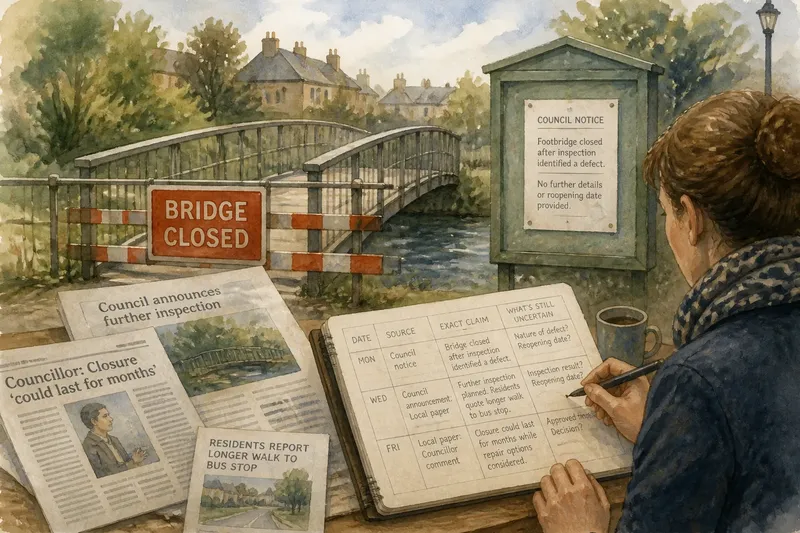
Imagine this invented situation: a council closes a footbridge after an inspection, then announces another inspection, while a councillor says repairs could take months. The first announcement gives no technical detail or reopening date. A short weekly record can show which statements are official decisions, which are conditional, and what the material you read does not yet establish.
Set a clear boundary
Give the file a narrow subject, such as “the footbridge closure”, rather than a broad label like “local transport”. Note when you begin and which question matters to you: for instance, whether a reopening date has been announced. This keeps unrelated developments from crowding the record.
For each item, retain the date, the source, and a short description of what that source actually says. Separate the source’s statement from your own interpretation. “The council says an inspection identified a defect” records an attributed claim; “inspectors found a defect” states it as established fact.
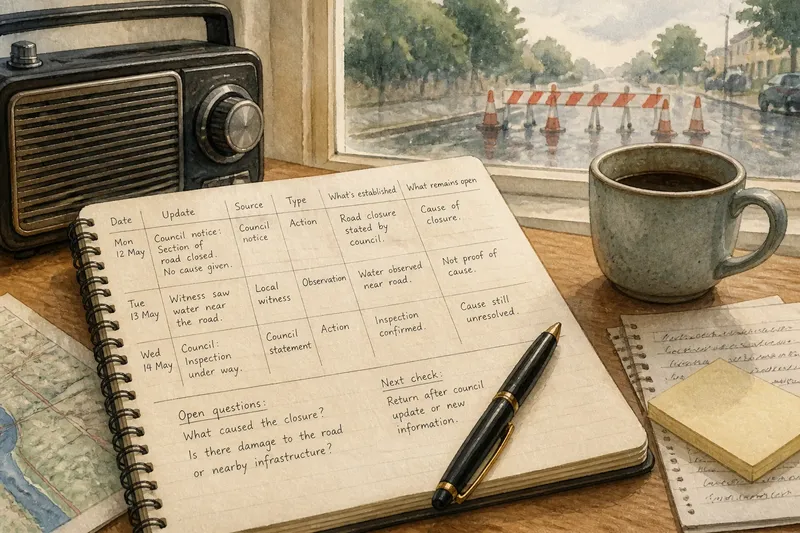
Use this compact set of fields:
- Publication date: Check when the item appeared; if it is clear, place it in sequence, but if it is missing or unclear, mark the date uncertain and avoid treating the order as precise.
- Source and item: Check the outlet, council notice, meeting record or named speaker; if the origin is identifiable, record it and a link or title, but if not, mark the attribution unresolved and do not rely on it as a firm account.
- Exact claim: Check who says what; if it is a direct decision or documented event, record that wording, but if it is a possibility or allegation, retain the qualification and seek the underlying statement before treating it as settled.
- New contribution: Check what the item adds beyond earlier material; if it supplies a distinct document, decision or account, add it, but if it only repeats an earlier report, note the repetition rather than counting it as independent confirmation.
- Remaining uncertainty: Check which detail the item leaves unanswered; if a relevant question remains open, state it plainly, but if the material answers it, close that question and record the answer with its source.
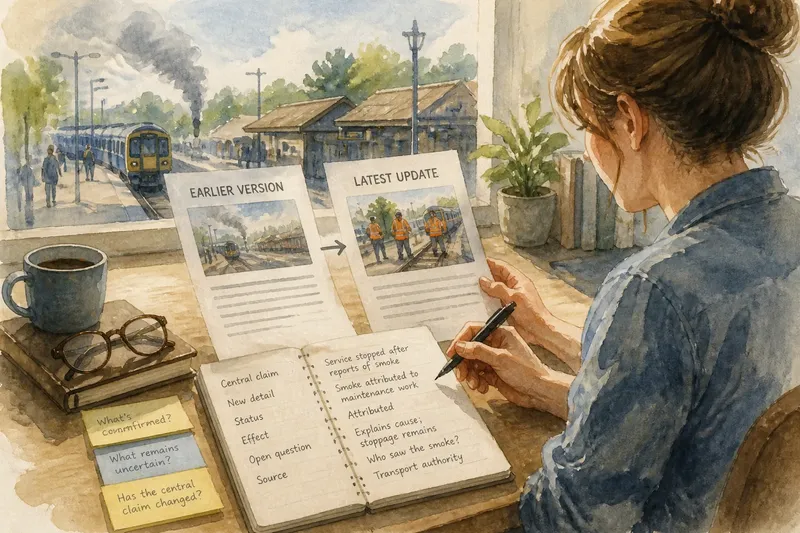
- Correction status: Check whether the item has been corrected, updated or withdrawn; if a change is stated, add a dated note and preserve the earlier version as superseded, but if no change is indicated, leave the entry intact and continue checking later updates.
Keep entries short enough to use while reading. A source link or document title lets you return to the wording if a later account appears to conflict with it.
Separate decisions from possibilities
An announcement, a plan and a prediction carry different weight. A council statement that a bridge is closed records the council’s position. A plan for another inspection describes an intended action, not its result. A councillor’s comment that closure could last for months expresses a possibility unless the account also reports an approved timetable.
In the invented bridge situation, the first entry might read: “Monday — Council says bridge closed after inspection identified a defect. Notice gives no technical description or reopening date.” The next entry could say: “Wednesday — Council announces further inspection; no result reported. Residents quoted by local paper describe a longer walk to the bus stop.” Each statement stays attached to its source and does not answer more than it can.
When an update uses words such as “could”, “plans”, “expects” or “has decided”, preserve them. They signal whether you are reading a possibility, intention, forecast or completed decision.
Work the record through
Say you begin following the invented bridge story on Monday. The council notice says the bridge is closed after a defect was identified, but gives no detail. You enter the date, the council as source, the stated reason and the missing timetable; your current answer is that closure has been announced, while the defect’s nature and the reopening date remain unknown from that notice.
On Wednesday, the council announces a further inspection, and a local paper quotes residents describing a longer walk to the bus stop. You add the inspection as a planned action and the residents’ account as a reported effect. The answer changes only this far: another inspection is planned, and residents quoted by the paper report a longer route; no inspection result or reopening date has been supplied.
On Friday, a newspaper reports that a councillor says closure could last for months while repair options are considered. You preserve “could” and attribute the statement to the councillor. The resulting record does not say the bridge will be closed for months: it says that one councillor raised that possibility, while the file still contains no reported approved timetable. That is the trade-off of cautious wording: it may sound less conclusive, but it preserves what each source actually establishes.
Review the week
Read the entries in date order and ask whether each newer item changes an earlier answer, adds a separate account, or merely repeats it. In the invented situation, the review can state that the council announced a closure and a further inspection, residents quoted by a local paper described a longer route, and a councillor raised a possible extended closure. If none of the material you read gives a reopening date, write exactly that: “No reopening date appeared in the sources reviewed.”
If a source later corrects a detail, add the correction with its date and origin. Mark the old wording as superseded rather than deleting it. The sequence will then show both what you read at the time and why your record changed.
Keep the file proportionate to the story. A brief note is more useful than a transcript of every article, particularly when multiple outlets repeat the same announcement. Add detail when it changes the record, not simply because another update has appeared.
Questions about the file?
How many sources should I follow?
Start with a source close to the event, such as an official notice, and use reporting that adds documents, context or distinct accounts. If several items repeat the same statement, record the original source and avoid treating repetition as separate confirmation.
What belongs in an open question?
Use a question that later material could answer, such as who approved a decision or whether a planned inspection has produced a result. If the wording assumes misconduct or a foregone outcome, rewrite it so it asks for information rather than implying an answer.
Should I keep entries after a correction?
Keep them, but mark the earlier wording as superseded and add the correction’s date and source. If the corrected item changes your account, update the current answer while leaving the record of that change visible.
When should I stop updating the file?
Stop when the story no longer needs regular attention for your purposes or when new items no longer change the record. If an important question remains unanswered, preserve it as unresolved without assuming an answer is imminent.
Leave room for change
A Sunday file for one ongoing story does not need to settle the story. Its value is a reliable distinction between a decision, a reported account and a possibility, alongside a clear note of what the material has not answered. When the next update appears, compare its wording with that record before revising your understanding.