How Statements, Documents and Witnesses Shape a Developing Story
Learn how statements, documents and witness accounts shape a developing story, and keep a clear record of what each item adds to the timeline.
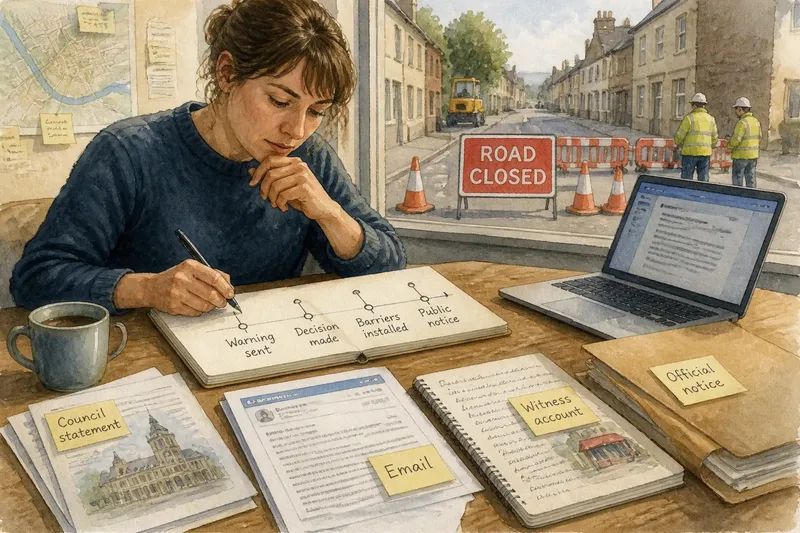
In a developing story, a council statement, a published email and a shopkeeper’s account may describe the same road closure while answering different questions. Treating them as interchangeable makes the timeline look firmer than it is. The value of each source lies partly in what it can add to the sequence—and partly in what it cannot.
For a developing story, think of source material as pieces of a timeline rather than votes for one version. A statement records an organisation’s account; a document preserves information in a particular form; a witness describes what they say they observed. Read each for its distinct contribution.
Build the timeline
Start by writing the events you are trying to place in order. A road closure might involve a warning being sent, a decision being made, barriers being installed and a public notice appearing. Keep each event separate. Evidence that a warning was sent does not, by itself, place the decision or establish that anyone acted on the warning.
For every item, record its date and the event it bears on. Distinguish the date an event happened from the date it was recorded, published or recalled. An email’s timestamp may help place a message in the sequence; a later statement may describe when an organisation says a decision occurred.
Use cautious wording in your timeline. “The email is dated Tuesday” describes the record. “The council received the warning on Tuesday” makes a claim about receipt that may need an acknowledgement or other support.
Read statements as positions
A press release, interview answer, social media post or spokesperson’s response establishes that a person or organisation made a particular statement. It can also show how that party describes its role and which parts of the sequence it addresses.
Check who spoke, in what capacity, where the statement appeared and when. Preserve the exact wording of any important passage. “We are reviewing the decision” does not mean the organisation has confirmed why it was made.
Compare the statement with the question it is meant to answer. If asked when a closure was ordered, an answer about when barriers appeared may concern a related event, not the decision itself. Note any terms—such as “aware”, “received” or “resolved”—whose meaning is left unclear.
If a news report paraphrases a statement, find the original where possible. A short summary can lose a qualification or make a limited answer sound complete.
Read documents in context
Letters, emails, meeting notes, notices and official forms can place details in a recorded sequence. First establish who created the item, its purpose and how it became available. A complete published email is different from a cropped image that leaves out its sender, date or surrounding text.
Then check its status and scope. Is it a final report, a draft, a form or one party’s filing? A document may establish that a claim was submitted or that a notice was issued; it does not necessarily establish that the claim was accepted or the notice acted upon.
Read the passage alongside its neighbouring paragraphs. A condition or definition elsewhere can change the meaning of a sentence pulled out on its own. Keep a note of the passage and the limited conclusion it supports.
A useful timeline entry might read: “The notice states that barriers were planned; it does not record when they were installed.” That wording keeps the document’s record separate from the event it describes.
Place witnesses in time
A witness account can add detail that a formal record may not capture: the order of visible events, a sound, or what a person noticed nearby. Its reach depends on what the person could directly observe.
Ask where the witness was, what they could see or hear, and when they gave the account. Separate observation from explanation. “I saw workers place barriers” describes an observation; “they were acting on the warning” adds a reason the witness may not know.
Accounts can also change as a story develops. A person may correct a time or detail after checking a message or discussing the event. Record what changed and why, rather than treating every correction as proof that the account is worthless.
Check whether apparently separate accounts come from separate observations. Several people repeating the same post do not add several independent views of an event.
What does each source add?
Can a statement place an event in the timeline?
It can show when an organisation says an event happened, but that is not the same as independent confirmation. Record the attribution and compare the account with dated records or direct observations.
Can a document show that someone received a message?
A sent email may show that a message was issued, but receipt is a separate point. Look for an acknowledgement, reply or other record before placing receipt firmly in the timeline.
What if witness accounts differ?
Compare each person’s position, timing and direct observations. Keep the disagreement visible, especially if the accounts concern different moments or vantage points.
How should a cropped item be used?
Use only what can be read and attributed confidently, and mark what is missing. Seek the full item if it is available before drawing a conclusion from an omitted date or passage.
Keep the sequence provisional
Imagine a council says it decided to close a road after receiving a warning. A published email is dated before the closure, but its recipient is unclear. A shopkeeper says they saw barriers appear later that day. The email places a warning in the sequence; the shopkeeper places the barriers later. Neither item alone establishes who received the warning or when the decision was made. The next useful check would be an acknowledgement or a record of the decision.
For each new item, note these details and let the result guide your next check:
- Date: Check whether the date belongs to the event or to the record; if it is only the record’s date, keep the event’s timing open, and seek a dated account.
- Origin: Check who created or supplied the item; if the origin is unclear, describe it as unverified material and look for an original or issuing source.
- Timeline point: Check which event the item addresses; if it concerns a neighbouring event, keep the two entries separate and seek evidence about the missing event.
- Direct wording: Check whether the item states a fact or records someone’s claim; if it is a claim, attribute it and compare it with a separate record.
- Completeness: Check for missing pages, context or attachments; if material is absent, limit the conclusion and seek the complete item.
- Independent origin: Check whether another account comes from a separate observation; if both rely on the same source, count them as one information chain and seek an independently originated account.
As updates arrive, revise the sequence rather than quietly replacing earlier uncertainty with a confident verb. “The council says it received a warning” and “the email records that a warning was sent” remain distinct statements until the evidence connects them. Keep the source beside the timeline entry, and note the next unanswered point. That small discipline makes the next update easier to assess without pretending it has settled the whole story.