The Headline Is Not a Verdict
Learn how to read a news headline against its supporting text, identify its framing choices and see what the article actually establishes.
A headline can say a minister “faces pressure” when the report describes criticism from one opposition politician. Reading the headline against its supporting text shows how a few compressed words select a frame—and what that frame leaves out.
Headlines choose a frame
A headline gives you a route into a story, not a miniature version of every detail. Its limited space means someone must choose which actor, action or consequence to foreground. That choice can shape your first impression before you know how the article is built.
Compare “Council approves housing plan” with “Council considers housing plan”. The verbs point to different stages. Even “approves” may need context: the council might have approved a proposal for consultation, not authorised construction.
Read the headline as an editorial decision about emphasis. Then check whether the opening paragraphs, later qualifications and any linked documents support the same frame.
Follow the story’s structure
Before judging a headline’s emphasis, notice how the article is organised. The first paragraphs may state the latest development, while later sections explain earlier events, include responses or describe what happens next. A detail placed low in the story may change how the opening reads.
Pay attention to chronology. An article may report that a committee has voted, then explain that the decision takes effect only after another body reviews it. The vote is the immediate event; the later review is part of its practical context. A headline that names only the vote may be accurate without describing the whole process.
Images, captions and pull quotes also guide attention. A photograph can make one person or location seem central even when the text concerns a broader issue. Check what the caption identifies and whether the article gives the image the same role.
Read beyond the opening before deciding what the headline makes central.
Check the headline’s verbs
Verbs carry much of a headline’s meaning. “Confirms”, “plans”, “warns”, “admits” and “faces” do different work. Ask what event or statement the verb refers to, and whether the article describes that event in the same terms.
“Company admits fault” implies more than “company apologises”. An apology can express regret without accepting responsibility. Likewise, “officials warn of disruption” reports a warning; it does not say disruption has occurred.
Words such as “accused”, “alleged”, “investigated” and “found responsible” also mark different stages. Replacing one with another can make a process sound settled when it is not. Look for the specific action described in the text rather than relying on the headline’s strongest verb.
Circle the verb mentally, then locate the passage that supports it.
Notice what gets foregrounded
A headline may foreground a person, a decision, a conflict or a consequence. That choice can be informative, but it can also make one element stand for a more complicated story. Look for details the headline leaves in the background: who initiated an action, which group is affected, or what condition still applies.
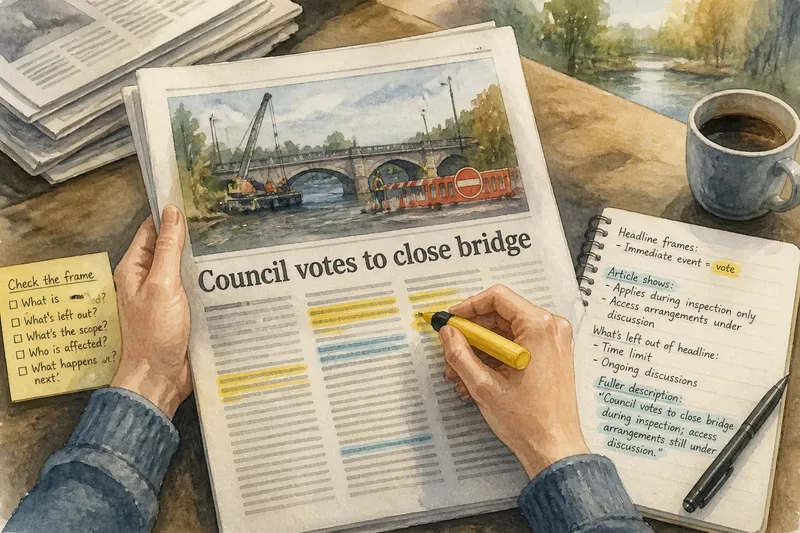
Imagine a local paper reports a council vote on a bridge closure. The headline focuses on the closure, while the article explains that the decision applies only during an inspection and that access arrangements remain under discussion. The first emphasis helps readers notice an immediate change; the later detail shows its limited scope. Both belong in an account of the story.
Compare the headline’s subject with the article’s recurring subjects. If the text gives sustained attention to a group or consequence that the headline omits, that omission may matter to your reading.
When does framing mislead?
What is placed first?
Check whether the headline leads with the event, the person making a claim or a possible consequence. Then see if the article gives that element the same prominence or supplies context that changes its weight.
What has been left out?
Look for a condition, time limit or affected group missing from the headline. If adding it would materially change how you describe the story, keep it in your account.
Does the image alter the frame?
Read the caption and compare the image with the text. If the photograph illustrates only one part of a wider story, avoid treating that scene as representative of the whole report.
Where does the article shift focus?
Notice when the text moves from the latest event to background, responses or possible next steps. A headline may foreground the update, while the later sections explain why its significance remains unsettled.
Describe the framing clearly
When you discuss a developing story, name both the headline’s emphasis and the context that qualifies it. For instance: “The headline leads with the bridge closure; the article says the council’s decision applies during an inspection, with access arrangements still under discussion.” This conveys the frame without letting it stand in for every detail.
Say you have read a headline about a council “approving” a housing plan. The article says councillors approved it for public consultation, and that a separate decision on construction is still pending. You can record the headline’s emphasis as approval, identify the article’s narrower event as approval for consultation, and note that construction remains undecided. The resulting description preserves the point of the headline while showing where its scope ends.
Reading a news headline against the article’s structure helps you spot what is prominent, what is secondary and what context shifts the emphasis. Keep the headline’s frame in view, but let the full sequence and scope of the report shape your description.