Before the Live Feed: How News Bulletins Made a Pause
News bulletins offered a pause for separating an update from a verdict. Use that rhythm to track what a developing story establishes and leaves open.
News bulletins made a pause visible: each edition had to stop somewhere, even when the story had not. That pause is useful for reading developing news today. It marks the boundary between what a report establishes at that moment and what remains unresolved.
A bulletin was not simply a shorter version of a complete account. Editors selected material for a particular edition, and listeners might hear no other. Its sequence offered a way into the day’s events, but its closing signal meant the edition was over, not that the story had reached a verdict.
Deadlines, not verdicts
A scheduled broadcast gave a newsroom a clear point at which to publish. Editors could include developments they considered sufficiently supported, while holding back claims that needed more checking. The result could be accurate and useful, yet still leave important questions open.
The interval before the next edition did not stop events. It gave reporters time to check new material and editors another chance to decide what belonged in the account. A later bulletin might add a verified detail, correct an earlier statement or make no substantial change.
When an old broadcast is replayed or quoted, its original moment can disappear. A statement that was current then may sound final now. Check the date and wording, and ask what the report could establish at the time it aired.
Sequence and emphasis
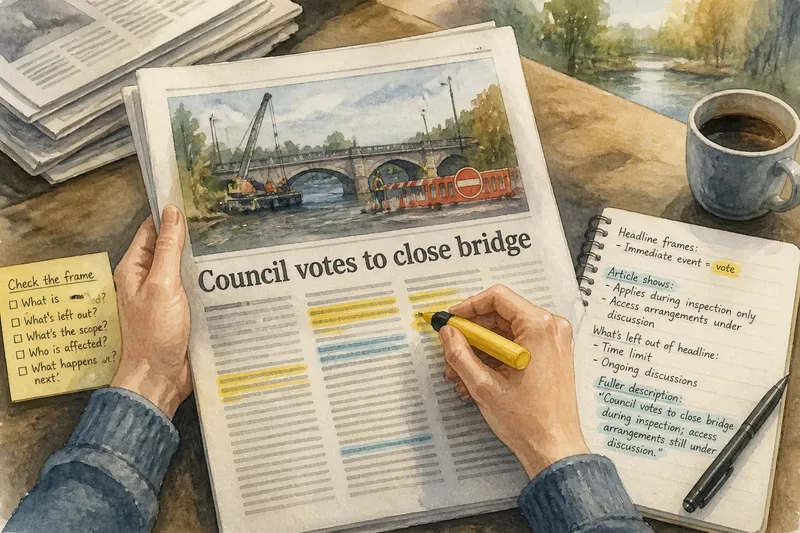
The order of items guides attention. A lead story sounds urgent; a brief item near the end may seem less important. That arrangement reflects editorial judgement, not a complete map of events or proof that one item caused another.
Separate a new event from the context used to explain it. An agency’s announcement establishes that the agency made a statement; it does not establish that every claim in the statement is true. A report may confirm damage at a location while leaving its cause uncertain.
Listen for the join between items. A transition can imply a connection, but the connection needs its own support.
Keeping a story record
A paper notebook or a simple text file can preserve the changing shape of a story without turning every alert into a new conclusion. For each update, note its date, the claim, who made it and what evidence or action the report describes.
- Claim: If the update describes an event directly, record it as an event; if it reports a position or explanation, label it as a statement and keep the attribution.
- Source: If the source has direct access to the matter described, note that basis; if not, preserve who the source is relying on and seek a source closer to the event before treating the claim as established.
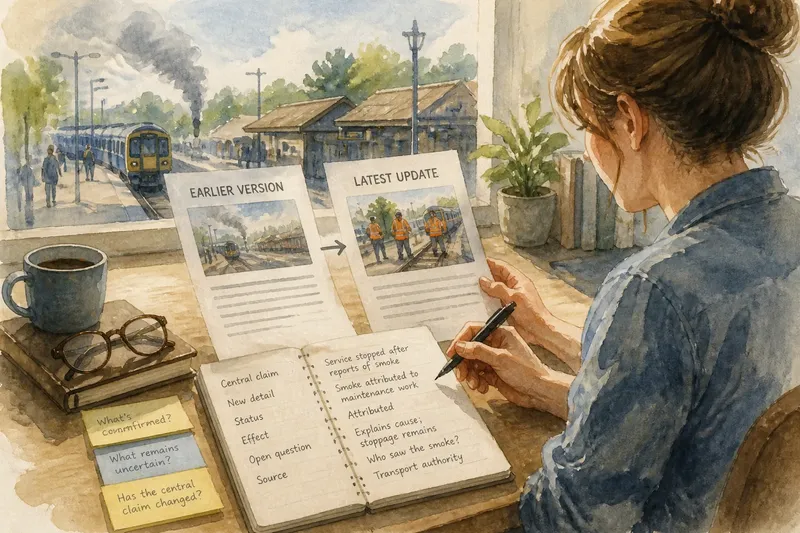
- Change: If the new item adds evidence or explicitly corrects an earlier claim, amend the record; if it only changes the headline or repeats a claim, mark it as no substantive change.
- Disagreement: If sources give conflicting accounts, record each account separately; if one has clearer evidence for the specific point, note that difference without erasing the other account.
- Unknown: If a question remains unanswered, write the precise question and what is missing; if it has been answered by later evidence, replace the open question with the attributed answer.
- Next check: If the story has a relevant new announcement or scheduled update, return then; if no material change is expected and you have enough information for now, stop checking until a useful prompt appears.
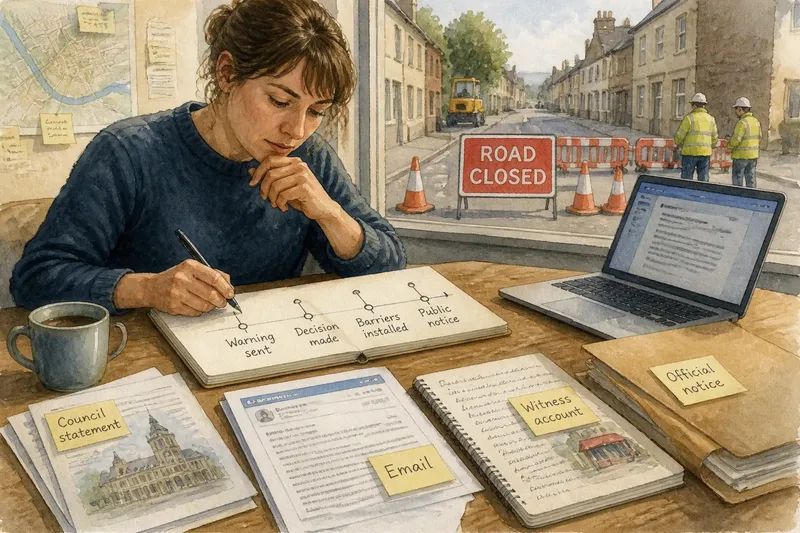
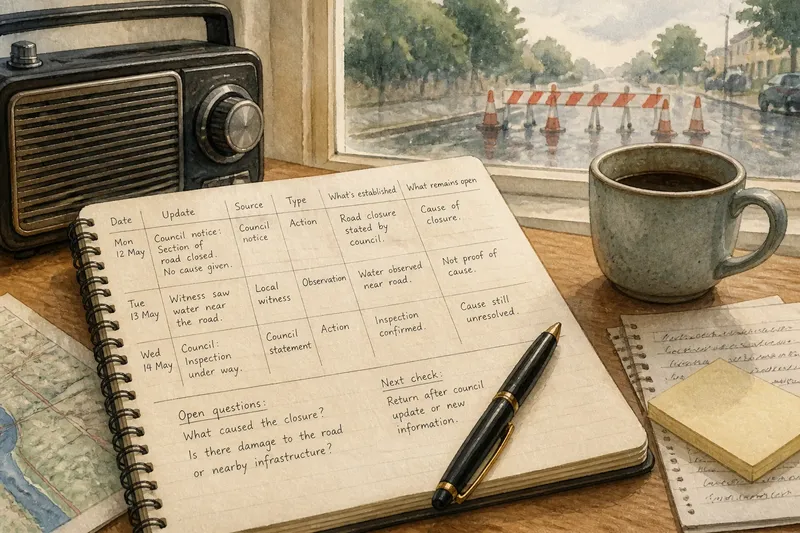
Say you are following a local report about a road closure. On Monday, a council notice says a section is shut but gives no cause. Record the closure as the council’s stated action and leave the cause open. On Tuesday, a witness says they saw water near the road; add that as an observation, not as proof of why the road closed. On Wednesday, the council says an inspection is under way. Add the inspection as a confirmed action, while keeping the cause unresolved. The resulting record distinguishes the closure, the witness’s observation and the inspection; it does not turn their sequence into a proven explanation.
Choose a checking time that fits the story’s significance. The point is to make each return useful, not to follow every new item.
What does a bulletin establish?
Does a later bulletin replace an earlier one?
Not necessarily. It may add a detail, correct a claim or repeat the earlier account because nothing material has changed. Compare the claim and its attribution, not just the publication time.
Why can two editions sound different?
They may use different evidence, wording or context. Check whether the underlying claim changed, or whether the later edition explains the same claim more fully.
When is an account complete?
Completeness depends on the question at hand. An edition can fully report that an agency made an announcement while leaving the announcement’s accuracy, consequences or cause unresolved.
How should an open question be recorded?
Write the specific question and identify what is missing. “The cause is not established” leaves a clearer opening for a later update than a general note that more is unknown.
Reading without an ending
A scheduled bulletin made the limits of a report easier to see. It captured what editors could publish at a particular point, bounded by the available reporting and the checks completed. That account could be dependable within those limits without covering what had not yet been established.
News bulletins still offer a useful rhythm for following developing stories: pause, identify what has changed, and leave the unresolved point in view. A live feed may place a document, a witness account and an official assertion next to one another, but their proximity does not make them equally well supported.
When you return to a developing story, ask what the latest item adds to the record and what it cannot establish. That question keeps the bulletin’s pause useful, even when the updates never stop.