What Changes When a Story Gets an Update?
Compare a news update with its earlier version, identify what changed and judge whether the new detail alters the story’s central claim or certainty.

A news update changes the story only when its new information changes what the earlier account established or what readers can reasonably conclude. To understand what changes when a story gets an update, compare the versions around one question: is the central claim stronger, weaker, narrower or simply more detailed?
A later article may add a location, identify a person, correct a time or include a response. These additions do not carry equal weight. The useful distinction is between a detail that alters the account and one that fills in its edges. Your reason for reading determines how much comparison you need.
When you need the gist
If you are catching up quickly, read the latest version first, then inspect its opening and any visible correction or update note. This suits a reader who needs the current account without reconstructing every change. Look for what has newly been confirmed, what remains uncertain and whether the original central claim still stands.
Do not treat a newer timestamp as evidence that every earlier detail has been revisited. An update can add one development while leaving other parts untouched. If an article says officials have confirmed a previously reported event, for instance, that may change the event’s status without resolving who was responsible or why it happened.
For a quick read, write the central claim in a plain sentence before reacting to the newest detail.
When the wording shifts
If the later version appears to say something different, compare the actual sentences, not just the headlines or social posts linking to them. This helps you decide whether an apparent reversal is real. Headlines are compressed; a change from “reports of” to “confirmed” in the article itself may matter far more than a sharper headline.
Find the earliest clear statement of the main claim in each version. Then check the subject, action, time and degree of certainty. A report that “the council is considering a closure” is not equivalent to one saying “the council has approved a closure”. A revised sentence may reflect a new decision, a correction or more exact wording.
Notice whether the article attributes the claim differently, too. “The agency said” identifies a source’s account; “the incident happened” presents the event directly. That shift can alter how firmly the report states something, even if the underlying event has not changed.
When you suspect a correction
If a name, place, number or sequence seems inconsistent, look for a correction notice, editor’s note or wording such as “updated to clarify”. This calls for checking accuracy, not assuming every revision signals a major change. A correction can fix a factual error while leaving the broader account intact; it can also reveal that an important earlier claim was unsupported.
Ask what role the corrected detail played. If an incorrect street name merely located an event nearby, the central claim may remain the same. If the mistake identified the wrong organisation as responsible, the correction may change the account substantially. The importance of an edit depends on its role, not on how conspicuous the revised word looks.
When no note explains a striking change, compare the publication’s own versions if available and check whether the newer text says why it changed. Avoid inferring motive from silence alone. If the change affects a consequential decision, wait for a clear explanation or consult a reliable, qualified source rather than relying on a fragment shared out of context.
When the story is moving
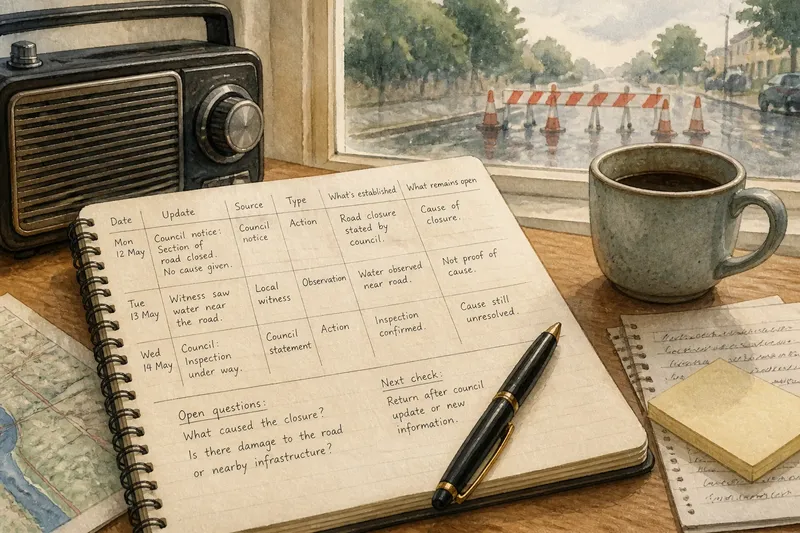
If events are unfolding, treat each version as a record of what was known at that point, not as a final account. Keep separate what is established, what is attributed and what remains unresolved.
A simple note helps prevent a reported possibility from becoming a remembered fact:
- Earlier account: If it states a clear central claim, record that sentence; if it does not, note that the claim is unclear rather than supplying one.
- New detail: If the later version adds or changes information, write down the precise detail; if you cannot locate a change, record that no specific change is visible.
- Status: If the detail is confirmed, attributed or disputed in the text, use that wording; if its status is unclear, mark it unresolved.
- Effect: If the detail changes or qualifies the central claim, describe how; if it leaves the claim intact, record that it adds context only.
- Open question: If the article names an unanswered point, preserve it in your notes; if it does not, write only that the article leaves the issue unspecified.
- Source: If the update attributes a claim to a named person or organisation, record the attribution; if it gives none, do not present the claim as sourced.
Imagine an early report says a train service stopped after smoke was seen near a station. A later update says the smoke came from maintenance work and that no fire was reported. Record the original claim as a stoppage following a report of smoke; record the new explanation as attributed to maintenance work; and note that the text does not establish who saw the smoke or whether every disruption had the same cause. The resulting conclusion is that the likely explanation has changed, while some details remain unresolved.
Keep uncertainty attached to the specific point it concerns. “The cause is not yet known” does not mean the stoppage itself is unconfirmed.
When the central claim may have shifted?
How do I find the central claim?
Look for the main event or assertion around which the article is organised, usually in its opening paragraphs. Put it into a short sentence naming who or what, what happened and any crucial qualification.
What counts as a meaningful update?
A detail is meaningful if it changes an actor’s identity, the nature or timing of an event, the level of certainty or the explanation the article supports. Added background may be useful without changing the main claim.
Why do two versions use different language?
The article may have gained better sourcing, been corrected or been rewritten for clarity as events developed. Compare the exact claim and its attribution before deciding whether the difference is substantive.
What if the latest version removes a detail?
Removal can signal correction, uncertainty or a decision that the detail is no longer relevant; the text alone may not tell you which. Check for an editorial note and avoid repeating the removed claim as established fact.
When the update adds context
Added background, a response or a wider consequence can change how readers understand an original claim, even when it does not alter the claim itself. Context may explain why an event matters without verifying that it happened as first described.
For example, a later report may add a statement from an organisation named in an earlier account. That response is new information about the dispute; it does not automatically settle the underlying facts. A previous incident may help explain why a development is receiving attention, but it is not evidence that the current event had the same cause.
Ask whether the update changes the main account, adds a relevant perspective or supplies background. These are distinct functions. An update can do more than one, but naming each function helps keep your conclusion proportionate.
Practical point: record context separately from confirmation, so background does not quietly become evidence for the central claim.
When versions cannot be compared
Sometimes the earlier text is unavailable, the page has been rewritten without a change note, or a social post links to a headline that no longer appears. Do not invent a before-and-after story from memory. Use what can be checked: the current wording, any timestamp or editor’s note, and the publication’s explanation.
If the distinction matters, look for another report that clearly describes the change, or wait until the publisher clarifies it. Different outlets may have different publication times and sources, so variation alone does not prove that one corrected the other. Be precise: the current article states one thing, while the earlier wording is unavailable.
A clear record of uncertainty is more useful than a confident reconstruction.
Make comparison count
When asking what changes when a story gets an update, do not count new paragraphs. Identify the added or revised detail, check how firmly it is stated and consider its effect on the central claim. The answer may be that the account has changed, its certainty has changed or the story is simply fuller.
Keep those outcomes distinct in your notes and conversation. “The report now says” differs from “the event is established”; “the explanation has changed” differs from “the earlier event did not happen”. That small discipline lets a news update inform your understanding without making it say more than the available account can support.